
As described in Section A.1. of the prospectus.
For the purpose of Tokenization, interested parties (Stockholder) contact the Issuer soliciting the issuance of Stock Certificate Tokens. In a first step, a Stockholder has to qualify as an acceptable counterparty to the Issuer through an onboarding process whereby the Issuer may be supported by service providers. Such onboarding entails habitual KYC, AML and other qualification processes as required by financial institutions (Onboarding).
After onboarding, the Stockholder transfers the underlying assets to a Custodian named by the Issuer in exchange for receipt of Stock Certificate Tokens.
For each specific stock or bond, i.e. each specific Underlying, specific Stock Certificate Tokens are issued. The Tokenization process is monitored by a Token-Trustee and is a step-by-step process where the delivery of the respective underlying assets into an account maintained by the Issuer with a Custodian triggers the minting and issue of Stock Certificate Tokens: (i) the Stockholder is instructed to transfer the underlying assets to the Custodian; (ii) the Custodian confirms receipt of the assets in an account of the Issuer held by the Custodian to the Token-Trustee, and (iii) the Token Trustee forwards the Stock Certificate Tokens it has received from the Issuer to a Wallet specified by the Stockholder (Wallet).
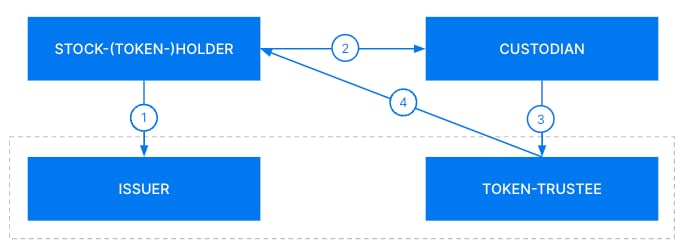
Image options
- Stock-Holder contacts the Issuer, after being properly onboarded, in order to contract the issue of Stock Certificate Tokens for the Underlying
- Stock-Holder transfers the Underlying into the deposit account of the Custodian
- Custodian informs the Token-Trustee about the receipt of the deposit of the Underlying
- Token-Trustee confirms receipt or the Underlying within the smart contract, which then triggers the minting of Stock Certificate Tokens into the wallet of the Stock-Holder, which concludes meeting all contractual conditions